
 Me to a friend who runs an online business: “How’s the launch coming?”
Him: “Great. I have the pre-launch funnel nailed down, the autoresponder finished, and now I just need to work on the pre-sell funnel and timed delay sequence.”
Online marketers often forget they are dealing with real breathing people (the horror!). We overcomplicate our interactions with autoresponders, marketing funnels, pre-sell funnels, timed launch sequences and exploding offers, which isn’t as scary as it sounds. It’s a classic catch-22: as we learn more about the psychology of why people buy, we end up creeping them out with overused tactics. Like a nervous guy at a bar talking to a woman while running through the checklist from “The Game” in his head, proven processes can only go so far. Paul Jarvis realized he didn’t need to “peacock” to get attention; he did the opposite. After getting the last lesson from his free email course, a refreshing final email arrives:
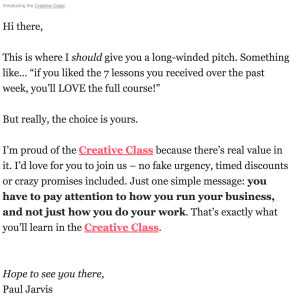 A few things to note:
- People tend to act weird as soon as they put on their “seller” or “buyer” hat. Paul addresses the elephant in the room and instantly relieves tension by poking fun at the traditional process.
- He establishes trust with the reader right away by striking a common bond. Putting himself in the buyer’s shoes. “I’ve been in those awkward fake-timed course launches myself and I’m not about to put you in the same bind.”
- He keeps things light, making me think as a reader “I could have a beer with this guy and he wouldn’t try to sell me life coaching.”
I often think of the quote “When you find yourself on the side of the majority, it is time to pause and reflect.” I think Mark Twain said it, but if he didn’t there’s a good chance he said something similar, since he tends to be the go-to guy for any quote. Just like most great comedians get laughs by pointing out the absurdity of life, online marketers can learn a lesson or two by pointing out some of the funny things we do to get people to buy our things.
The big takeaway? Whenever dealing with a sales situation, whether selling a couch on Craigslist or creating a complex opt-in funnel, do your best to diffuse tension in a light-hearted way. One of my former bosses was a master at this in the world of enterprise sales. Here we were, getting on a call with a CEO of a 1000+ person company, trying to sell a software contract that would bring in a lot of money. Tensions were high, and then he would take control. He’d slip in a sly comment about how this is usually the call where everyone tries to dance around price and try to prove their negotiation skills. Instead, he said, we were just going to send over a draft contract with nothing implied, they were going to get their red pens out and send back what they didn’t like and we’d go from there. It was amazing how quickly the tension diffused – a collective sigh of relief hung for a moment on the conference call line. A few weeks later, we closed the biggest contract and we avoided some seriously awkward moments.